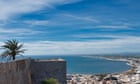
Growing up in the Maghreb, novelist Leïla Slimani remembers when the Mediterranean sea was not a border but the outline of a community, joining Africa to Europe
What if the future of freedom were being written in the Maghreb? What if we looked to the other side of the Mediterranean to find the most exciting collective adventures, to discern the outline of a new form of democracy where people questioned violence, economic power and the development of society in a new way?
Between 2011 and 2019, popular uprisings changed the destinies of first Tunisia and then Algeria. I was on Avenue Bourguiba when the Jasmine revolution began, and I have some extraordinary memories of those moments shared with the Tunisian people. I covered Zine al-Abidine Ben Ali’s Tunisia as a journalist from 2008 to 2011, and I had the feeling at the time that this country and its youth were dying. Young people were being driven to illegal emigration and suicide by the nation’s ills: police brutality, the economic crisis, endemic corruption and mass unemployment. Tunisia had been undermined so deeply and systematically by its ruling regime that it was hard to see a way out of the situation. In Algeria, similar causes produced comparable effects. And there was a sense of amazement there too, among observers and the protesters. As the Algerian journalist and author Kamel Daoud put it: “We had forgotten that we were a people, and in the street, we were united once again, amid joy and laughter.”
Source: Europe has turned its back on the Mediterranean – but there is still hope


